Brendle Heats His Greenhouse with Fryer Oil
Ever wonder why your neighborhood supermarket is stocking apples from the Pacific Northwest or even China instead of varieties grown closer to home? Ever notice how watery and bland supermarket tomatoes taste? Usually they’re grown across the country, in California, picked while green to ripen in transit. Worldwatch Institute reports that “in the U.S., food typically travels between 1,500 and 2,500 miles from farm to plate, as much as 25 percent farther than in 1980”. Because, until recently, the fuel necessary to transport food for distribution has been relatively cheap, the agribusiness model, with its continued consolidation of commercial food growing and processing centers, has been considered the most efficient way to distribute food. In fact, many of the costs of this system have been externalized, that is, not taken into account. In addition, the commercial farming this system depends on is heavily subsidized by taxpayers. In reality, the environmental, economic and social impacts of corporate farming are staggering.
Philadelphians are growing ever more aware of the benefits of supporting locally grown fresh food. Consumers who buy locally produced food are not only getting better, tastier, fresher and therefore more nutritious food, they are also helping to keep their dollars local, helping their rural neighbors, and fostering a stronger community economy that benefits everyone in the area. They can also feel good that they are contributing to a more sustainable model of farming- one that doesn’t impact the environment so heavily due to transport and the extra packaging that makes necessary.
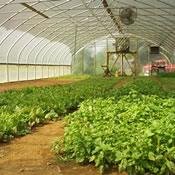
Green Meadows Farm, just outside of Philadelphia, is run by Glenn Brendle and his family. They provide much of the delicious, fresh food used in premier Philadelphia restaurants, including the White Dog Cafe. I spoke with Brendle about some of the creative ways he’s found to compete with larger-scale commercial growers organically, and with integrity.
People generally have no idea what goes into the food they eat, so I was hoping you could discuss how local, organic farming allows people to have a better handle on what they’re eating.
Well, now buying local and buying organic are not always the same thing. Over the years the organic movement has increased the general public’s understanding about what kinds of things are used to produce food. By that I mean pesticides and things. And as that consciousness was raised, the government became more involved. Today, many of the things that were at one time the major culprits in tainting the food supply are basically outlawed. A lot of the pesticides and herbicides that were used even as few as five or six years ago are now being phased out.
In that respect, that consciousness has served a valuable purpose. As time has gone on, more and more commercial farmers are using things that are very similar to the kinds of methods organic growers have been using for years. Because the kinds of things they used to use aren’t available anymore, because the government has made them stop.
Well, that’s really good news.
It is excellent news. And actually the commercial growers in many ways are finding out many of the lessons that we’ve known all along- that you don’t need all those things. There are a few things they’re having a tough time getting along without, but by and largely most of what they were using was overkill. And you don’t really need to use incredibly virulent pesticide against even the most troublesome insects. Most are fairly easy to kill. In fact, aphids you can kill by knocking them off the plant with a high-pressure stream of water.
In a way, commercial farmers were as much a victim as the public was. The growers were victimized by the chemical companies who said, oh you’ve got to have this stuff. Not being chemists, they didn’t know differently and it took them a while to figure out that they didn’t need it. And the government got into the act and actually outlawed some of the most poisonous stuff.
What about Round Up?
Well, Round Up is a contradiction to what I just said. That’s part of a different kind of technology that’s just over the horizon. The Round Up ready thing was made possible by genetic modification, and there’s a big backlash right now against genetic modification. When that comes full circle I think those things will also be eliminated. I’m looking forward to that. At the present time those things still exist and are things you have to be aware of. There hasn’t been a complete reversal of the ’50s, ’60s and ’70s chemically-dependent agriculture, but it’s going in the right direction. I think it’s just a matter of time until the rest of it comes around too.
That sounds pretty hopeful-
There are still problems, I don’t mean to make light of it, but I try to be as optimistic as I can be. By no means is that the end of the problems. But I think we’ve sort of turned a little bit of a corner. More and more people are starting to realize that not only are these things not necessary, but they’re very costly. That’s really what’s going to make the difference in agriculture in the long run. A lot of these chemicals are very expensive to use and if they’re not absolutely necessary, why bother? The real point I was trying to make was I personally like and practice organic agriculture, even though I’m not certified, and I do it because it’s the least expensive way to go. I despise the idea of putting more into the field than you need to. I think it’s really stupid to buy expensive sprays to put on your crop when it’s really just totally unnecessary. Everybody who’s a small farmer these days is faced with the same problem- the only way to make a profit is you can either raise your prices or lower your overhead. You’re sort of boxed in by the market, so you really have to try to figure out ways to lower your overhead. We’ve been fighting that battle for the last 20 years. And we’ve had some pretty significant successes.
But the local feature is the most crucial part of the whole thing. Personally, I would rather eat commercially grown local food than organically grown shipped food. I see no advantage to eating organic food from halfway around the world. I mean, if it’s something out of season, or if you want a real treat, something from somewhere else like bananas or oranges that you can’t grow here, that’s fine. I’m not talking about that. But if you’re going to eat broccoli, I would rather eat local commercially grown broccoli than organic broccoli from California for two reasons. First is, by the time it gets here from California, it’s already several days old. And then it sits with the distributor in their cooler a few days, and then sits in the store cooler for another day or two, and by the time you pick it up, it might be a week old. And I don’t want to eat week old broccoli. Number two, the broccoli that comes from here is frost tempered, winter-chilled. When the frost touches the broccoli, it produces sugar in order not to freeze. It becomes lovelier somehow- sweeter and more delicious. The flavors are enhanced. California broccoli never gets cold. You should take the greatest advantage of what can grow locally and eat what really stands out as delicious locally.
In this climate you can eat things that are frost tempered that you can’t get from California. And you can also get the freshest tomatoes. The tomatoes we take to the restaurants in Philadelphia in the summertime are picked one day and delivered the next right on the vine. And it makes a huge difference between that and the tomato that’s picked green and ripened in a box. There’s just no comparison. It’s taken a long time for people to realize it, but I think consumers are starting to become more knowledgeable. There’s a resurgence of interest in local grown food. If it’s local organic, then so much the better.
It’s good to know there’s not a lot of chemicals in commercial agriculture anymore.
Well, the key is there’s not a lot, there’s still some. But I look at things from the farmer’s perspective. I want to be optimistic about it. The farmers I talk to are interested now more than ever in saving money, using the least insidious chemicals and the least expensive methods. And without fail, the most expensive solution to a problem also always has the greatest impact on the environment. For instance, I use a lot of soap and vegetable oil spray. It works great on any kind of soft-bodied insect. It’s cheap and easy to make. You spray that, and all it does is smother the insect. It’s extremely low impact. And it’s cheap, that’s the beauty part of it. And the other great advantage is it’s one of the only insecticides that actually kills the insect’s eggs. So there’s even more benefits.
I have a garden in the city, and I know I’m always looking for just those kind of tidbits, I think a lot of people are-
There are a lot of things like that. You just have to poke around a little but you’ll see more and more people starting to tune into things like that.
A lot of the organic methods work really well on a small scale. You know that show, You Bet Your Garden? They’re great if you have five plants. I’d do it too if I only had a few plants. But when you’re out there facing a half-acre of something or even a couple two hundred foot rows and they tell you just to pick off the potato beetles in the spring, well, it just doesn’t work for me. However, if someone tells me I can put a soap and vegetable oil emulsion in my commercial sprayer and go out and spray those rows, and accomplish the same result, I’m all ears. You’ve got my attention. We try to do the things that are scalable and have minimal impact.
Let me ask you about your greenhouse operation. I know you converted to biodiesel-
No, not biodiesel, straight vegetable oil. There’s a big difference. Biodiesel is made by taking vegetable oil and converting it to a different sort of a fuel by treating it with lye and ethyl alcohol. In a nutshell, what you’re doing is you’re making soap and then you take the glycerol away from the mixture, you have to do something else with that, and what you’re left with is a fuel that’s a little thinner than vegetable oil and it doesn’t gel. That’s what biodiesel is. What we do is use straight vegetable oil just like it comes out of the deep fryer, and we heat it. We put it through a modified waste oil burner, and essentially burn it just like a grease fire on your stove, and use that for heat. There again, my big contention with biodiesel is, well, it works fine… I hate to be knocking people who are trying to do the right thing. But I have a problem with biodiesel because basically, there’s a lot of environmental impact with certain kinds of fuels.
To make biodiesel for example, you need lye, which is very caustic. And you need ethyl alcohol which is also fairly poisonous. And then when you’re done making biodiesel you end up with a compound called glycerol which you have to do something with. Well, if you have a soap plant in your backyard, you can make soap out of it, but I don’t have a soap plant and I don’t need two and a half tons of soap. Basically, I collect 12 to 15 thousand tons of vegetable oil a year, so that would be a lot of glycerol. People say, well you can compost it. Well, yes, you can, but then you have to figure out how you’re going to control it so it doesn’t run all over the place in your compost pile. I looked at all these things, and I had several choices when we first started. I knew I had a fuel. I knew I could collect a lot of this vegetable oil in the city, but I didn’t really know exactly what to do with it. I checked out biodiesel, but I thought by the time I buy all that ethyl alcohol and all that lye, and figure out what to do with the glycerol, I might as well just go out and buy heating oil. So then I thought, well, I could mix it partially with my regular heating oil burner. Then I thought maybe I could burn it straight in a waste oil burner, and it worked. And I’ve been doing it ever since.
Basically, all I end up with as a by-product is what goes out the stack. There’s a little bit of carbon dioxide, not much, a little bit of nitrous oxide, that kind of thing. But all that stuff that goes out the stack was just in the ground a year ago. It was in the groung in the form of the plants that they used for the oil. It could be corn, it could be soy beans, it could be peanuts. They pressed the oil out of that plant, and that oil got burned by me, and went back into the atmosphere, and by next year, the amount of stuff I burn will be back in another plant. So there’s a carbon cycle there. The difference is that what I’m burning was just in the environment before I burned it. What the fossil fuel guys are burning was out of the environment for millions of years and now it’s all of a sudden being put back in.
Oh yeah, that makes sense-
If you’re adding to the carbon cycle, then you’re part of the problem. If you’re burning something that’s been sequestered or stored up until now than that’s a problem. But if you’re burning something that’s a part of the process, you’re returning something that already existed in the environment. Not that you shouldn’t be trying to figure out ways to take out more carbon. But anyway, we don’t add anything as far as the carbon cycle is concerned. And the other thing is, what we end up with after the oil burns off is this little bit of flour and french fry sludge at the bottom of the barrel. We end up with about an inch or two of this sludge from each barrel. We combine all of it and burn it, and then what’s left from that, we take out and pour on the driveway and pave our driveway.
That’s great!
That’s better than putting tar down, because tar is a fossil fuel, so when you’re putting tar down you’re putting something into the environment that was sequestered for millions of years. Most people don’t even think of the fact that all this paving that we do is a part of the global warming problem. Because as you put that tar out, as you expose it to the air, it oxidizes and basically, at a much slower rate, you’re putting additional carbon, formerly sequestered carbon, into the environment. The other advantage with the vegetable oil sludge is that it’s somewhat pervious to water, so the water can actually percolate through it and there’s not a lot of runoff. So, those are the only effluents from our heating process. I’m kind of proud of that. It’s great to be able to do these things without adding a lot to the environmental impact.
What kind of permaculture techniques do you use? Do you set up ecosystems for your plants, using complementary planting and methods like that?
Oh yeah, I do that out of self-preservation. I’ll give you an example. We have several greenhouses. The oldest one has been here for fourteen years now. You look around in the greenhouse and the worst problem is fighting weeds, because at least outside you can plow the ground every year, and you return one cycle of weeds underground. When you plow, you turn up a fresh batch, but you turn another cycle down, and they might not return after winter. So you get a break. But for any farmer, weeds are the biggest problem.
So I kept pulling up weeds whenever they came up in the greenhouse. Primarily you’re trying to keep nothing growing in those spots where the weeds come up. So then I thought there are a lot of weeds that are not bad, so if you can encourage the right weeds and discourage the wrong ones, then the right ones turn out to be something you can use. One of the things I encourage fairly successfully is purslane. And that can be a pretty aggressive weed, but it also makes a pretty good salad green. And the other one is chickweed, which is also a nice salad green. So we encourage the good weeds and pull out the ones we don’t want. That’s one of the ways we get around trying to weed things. In the greenhouse we encourage miner’s lettuce. It’s a nice little compact plant and it’s real tasty. And there are others. But it’s all basically about making a living. Doing less work for the crop.
Can you give some ideas of your struggles on the farm?
The biggest problem is trying to keep the greenhouse balanced. For instance, when I grow tomatoes and cucumbers we use the vegetable oil jugs and I punch holes in the sides and hang them up. There’s an example: I used to grow tomatoes in the ground and hang string down from the top of the greenhouse and train the tomatoes up the string. And it’s a lot of work. Then I thought, why not use gravity? Why am I fighting gravity? So I got this idea to clean out the vegetable oil jugs and hang them from the top of the greenhouse and let the cucumbers and tomatoes grow down. And this worked so well we use it every year now.
Well, the white flies love tomatoes, they love cucumbers. Now a regular grower would try to maintain sterile conditions. Well, I’m not into sterility. What a regular grower would do, he would basically fumigate his house, he would palnt his tomato and cucumber seeds in a sterile house with biosecurity and strong sprays. He wouldn’t introduce the insect to begin with, and if it came, he would hit it as hard as he could and try to get rid of it. Well, white flies evolve pretty rapidly and they’re pretty hard to deal with. So what do you do? We buy these predator wasps. What they do is, they parasitize the white fly eggs. And it all works well if you keep the greenhouse nice and warm, which we do. The problem is every once in a while you’ll get an outbreak of aphids. Well, white flies predators don’t effect aphids. you could buy other predators, but they don’t work that well, or you could spray with the soap-vegetable oil emulsion, but that also kills white fly predators, so then you knock that out of balance. Then you have to start over again. I mean, it’s not that difficult, we do it. But I wish there were an easier way.
With a grant from the White Dog Cafe Foundation’s “Pigs in Grass” program, Brendle expects to start raising pigs next Spring. His method is to let them run free and forage in his wood lot, because that’s what pigs really like. It’s just another example of how Brendle has found a way to combine efficiency with sustainability. It all adds up to delicious food grown with heart.
Find out more about Green Meadows Farm and the Brendles by vising their website, which also lists their food inventory.
2006-11-05 16:46:09